
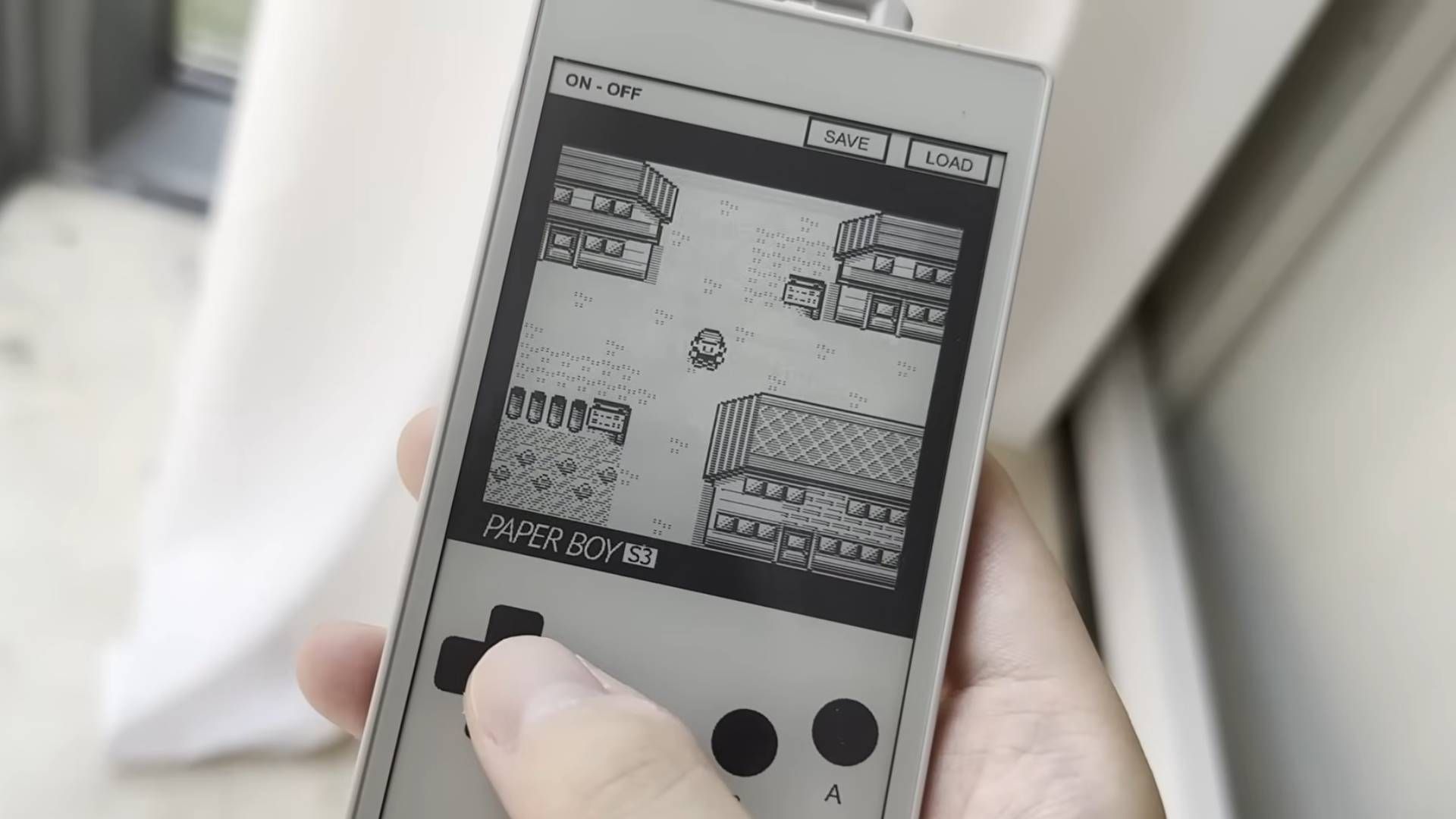
I love the deep blacks and vibrant colors of a modern OLED monitor as much as anyone, but the price of entry remains a hurdle for many. While I’ve always been curious about low-fi alternatives like e-paper, the notorious ghosting and sluggish refresh rates have kept me away—until now. Hardware creator Wenting Zhang has unveiled a custom Game Boy emulator that challenges the limitations of e-ink, making Pokemon Blue look surprisingly smooth on a portable display.
- Platform: M5Stack PaperS3 E-Ink reader
- Core Hardware: ESP32 SoC
- Primary Use: Original Game Boy emulation
- Audio: Filtered single-tone synthesis
How It Works
To pull this off, Zhang didn't just slap an emulator on a stock e-reader. The project leverages an ESP32 SoC and the pocket-sized M5Stack PaperS3, but the real magic is in the driver. Zhang spent four years prior to this project developing an e-ink monitor capable of 60fps, and they have applied that same technical approach here. By using significantly more memory than a standard e-reader, alongside a clever mix of dithering and greyscaling, the device achieves a refresh rate that is, quite frankly, impressive for the hardware.
It is worth noting that while Pokemon Blue runs well, Game Boy Color emulation is still a work in progress due to various hardware and software constraints. For those interested in the technical side, the project is open source, allowing you to peek under the hood or even try building your own if you want to push the limits of e-paper tech.
Audio and Usability
Because the M5Stack PaperS3 wasn't designed for gaming, the onboard speaker was a major bottleneck. Zhang solved this through some creative audio engineering, filtering the classic Pokemon soundtracks through a single, crunchy-sounding tone. It isn't exactly high-fidelity, but it has a distinct, charming character that fits the aesthetic.
When it comes to actual playability, the device shines with slower-paced, visually simplistic games like Pokemon Blue or The Legend of Zelda: Link's Awakening. However, if you are looking to play something faster like Tetris, you might find the M5Stack's built-in touchscreen a bit lacking. Zhang admits that Bluetooth controller integration is still a bit rocky, so your mileage may vary depending on the game.
Personally, I am already eyeing the open-source repository to see if I can repurpose this 'Paperboy' build as a dedicated device for visual novels. If you're looking for a project that breathes new life into retro hardware, this is definitely one to watch.
Sony Stays Quiet on PS6 Release Date, Refuses to Mimic Xbox RoadmapHandheld Gaming
MONOPOLY: Star Wars Heroes vs. Villains Hits Xbox Series X|S TomorrowAnalysis
Akira’s Manga Ending: Why It’s the Definitive Cyberpunk ConclusionBaldur's Gate 4
Why Baldur's Gate 4 Isn't Happening at Larian Studios